Afghanistan: No justice for thousands of civilians killed in US/NATO operations

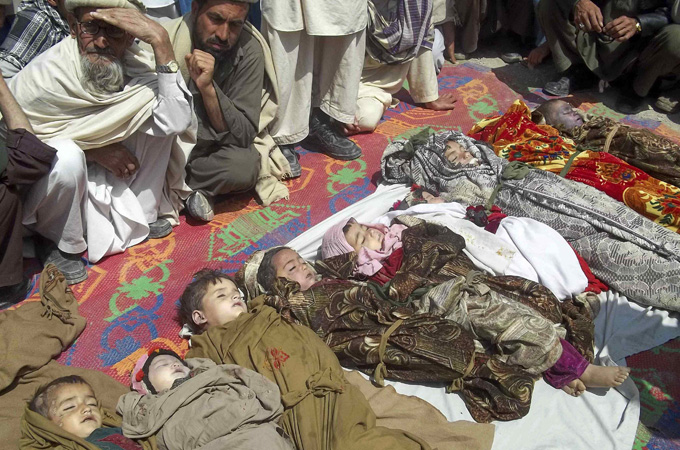
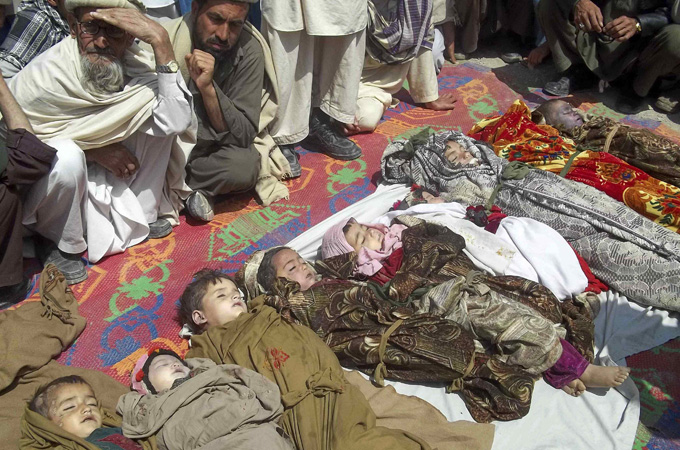
April 7, 2013: A NATO airstrike killed 10 children and 8 other people in eastern Kunar province of Afghanistan. (Photo: Reuters)

The families of thousands of Afghan civilians killed by US/NATO forces in Afghanistan have been left without justice, Amnesty International said in a new report released today. Focusing primarily on air strikes and night raids carried out by US forces, including Special Operations Forces, Left in the Dark finds that even apparent war crimes have gone uninvestigated and unpunished.
“Thousands of Afghans have been killed or injured by US forces since the invasion, but the victims and their families have little chance of redress. The US military justice system almost always fails to hold its soldiers accountable for unlawful killings and other abuses,” said Richard Bennett, Amnesty International’s Asia Pacific Director.
“None of the cases that we looked into – involving more than 140 civilian deaths – were prosecuted by the US military. Evidence of possible war crimes and unlawful killings has seemingly been ignored.”
The report documents in detail the failures of accountability for US military operations in Afghanistan. It calls on the Afghan government to ensure that accountability for unlawful civilian killings is guaranteed in any future bilateral security agreements signed with NATO and the United States.
Amnesty International conducted detailed investigations of 10 incidents that took place between 2009 and 2013, in which civilians were killed by US military operations. At least 140 civilians were killed in the incidents that Amnesty International investigated, including pregnant women and at least 50 children. The organization interviewed some 125 witnesses, victims and family members, including many who had never given testimony to anyone before.
Two of the case studies — involving a Special Operations Forces raid on a house in Paktia province in 2010, and enforced disappearances, torture, and killings in Nerkh and Maidan Shahr districts, Wardak province, in November 2012 to February 2013 — involve abundant and compelling evidence of war crimes. No one has been criminally prosecuted for either of the incidents.
Qandi Agha, a former detainee held by US Special Forces in Nerkh in late 2012, spoke of the daily torture sessions he endured. “Four people beat me with cables. They tied my legs together and beat the soles of my feet with a wooden stick. They punched me in the face and kicked me. They hit my head on the floor.” He also said he was dunked in a barrel of water and given electrical shocks.
Agha said that both US and Afghan forces participated in the torture sessions. He also said that four of the eight prisoners held with him were killed while he was in US custody, including one person, Sayed Muhammed, whose killing he witnessed.
Formal criminal investigations into the killing of civilians in Afghanistan are extremely rare. Amnesty International is aware of only six cases since 2009 in which US military personnel have faced trials.
Under international humanitarian law (the laws of war), not every civilian death occurring in armed conflict implies a legal breach. Yet if civilians appear to have been killed deliberately or indiscriminately, or as part of a disproportionate attack, the incident requires a prompt, thorough and impartial inquiry. If that inquiry shows that the laws of war were violated, a prosecution should be initiated.
Of the scores of witnesses, victims and family members Amnesty International spoke to when researching this report, only two people said that they had been interviewed by US military investigators. In many of the cases covered in the report, US military or NATO spokespeople would announce that an investigation was being carried out, but would not release any further information about the progress of the investigation or its findings – leaving victims and family members in the dark.
“We urge the US military to immediately investigate all the cases documented in our report, and all other cases where civilians have been killed. The victims and their family members deserve justice,” said Richard Bennett.
Thousands of Afghans have been killed or injured by US forces since the invasion, but the victims and their families have little chance of redress. The US military justice system almost always fails to hold its soldiers accountable for unlawful killings and other abuses.
The main obstacle to justice for Afghan victims and their family members is the deeply flawed US military justice system.
Essentially a form of self-policing, the military justice system is “commander-driven” and, to a large extent, relies on soldiers’ own accounts of their actions in assessing the legality of a given operation. Lacking independent prosecutorial authorities, it expects soldiers and commanders to report potential human rights violations themselves. The conflict of interest is clear.
In the rare instances when a case actually reaches the prosecution stage, there are serious concerns about the lack of independence of US military courts. It is extremely rare that Afghans themselves are invited to testify in these cases.
“There is an urgent need to reform the US military justice system. The US should learn from other countries, many of which have made huge strides in recent years in civilianizing their military justice systems,” said Richard Bennett.
The report also documents the lack of transparency on investigations and prosecutions of unlawful killings of civilians in Afghanistan. The US military withholds overall data on accountability for civilian casualties, and rarely provides information on individual cases. The US government’s freedom of information system, meant to ensure transparency when government bodies fail to provide information, does not function effectively when civilian casualties are at issue.
Amnesty International also urges the Afghan government to immediately establish its own mechanism to investigate abuses by the Afghan National Security forces, who will assume full combat responsibility by the end of 2014.
Amnesty International Report

Sorry Latifa, You are a Hazara !

by an Independent Journalist ; Muhammad Younas 

10574266_682595515149584_837285246293709056_n

It was a pleasant day in Lal-o-Sar Jangal, Ghor Province Afghanistan. Latifa was thrilled since morning because she was going to Kabul City with her husband today for the honeymoon. Her husband, Nauroz had already told her to get all necessary stuff ready by 10pm.

Nearly a month ago, she got married with Nauroz, his village mate. She was just 22 years old, a young lady with full of dreams to enjoy the marriage life. It was early morning, when she left her bed to start the day but it was not the routine day. She couldn’t sleep properly as the honeymoon excitement kept her awake nearly all night. She hurriedly prepared breakfast for the family. Her blood was running fast in her veins. She seemed flying today—feeling over the moon. She wanted to finish all house chores as quick as possible and she also wanted to finish packing before the set time.

In the evening, her parents visited her home to see off her. She cooked a sumptuous dinner for the family. All family members enjoyed the dinner. Latifa promised to bring beautiful wool shawls, scarves from Kabul and warm shoes for her mother-in-law.

It was around 10pm, when her husband asked her to leave home. She kissed her elders’ hands to seek their blessings. In traditional Hazaragi dress, she was looking stunning with a bridal scarf. They both left home and arrived at the bus station, where a mini-bus was waiting to get them on board. The driver put their bags on the roof and tied them up. The commuters took a sigh of relief when the bus started moving forward.

“We will arrive in Kabul in the afternoon,” the driver said loudly and sped the bus bit fast.

“Why the bus doesn’t go in the morning?” she asked her husband inquisitively.

“It’s safe at night rather than in the day light,” Nauroz replied confidently.

The mini-bus was going slowly but the commuters could easily feel the jerk and the bump as it was running on the rough and unpaved road. The bus was swaying to either side when it moved bit fast. However, Latifa wasn’t feeling the knock and jolt because she was thinking about Kabul City, her honeymoon.

“Do you know which place we should see first in Kabul?” she asked.

“What do you think?” her husband replied.

“I don’t know. This is my first time going to Kabul.”

“After lunch in Kabul, we’ll take a rest for a few hours, and then we’ll go to the cinema. We’ll watch a Hindi film. What do you think?”

“Sounds great to me.”

She didn’t know how Kabul looks like. She heard a lot about Kabul City, especially Bagh-e-Babur, Bagh-e-Bala, Qargha, Kabul Zoo, cinemas and of course shopping malls. The beautiful national park Band-e-Amir and historical Bamiyan city known for its giant Buddhas were also in her list before coming home.

When the bus reached Feroz Koh, it stopped.

“Why it’s stopped?” she asked curiously.

“I think, it’s a normal checking by the authorities—not to worry,” her husband explained.

Three bearded armed men got on the bus. One of them put the gun on the head of the driver and shouted to get off the bus.

“Who are they? What are they doing?” she asked nervously.

“I don’t know—may be Taliban. Don’t know,” Nauroz said fearfully.

Both of the armed men were pulling commuters off the bus. She couldn’t believe her eyes, when a dark bearded armed man with thick eyebrows and a large nose dragged her out of the bus. She was horrified. She was made to line up beside the bus with other commuters. She also saw more armed men who were getting passengers out of the three buses and were lining them up. The women and children were crying. Armed men were asking everybody to show their ID Cards. She didn’t know, why they were asking ID Cards?

After checking ID Cards, the armed men were letting some commuters to go, while some others’ hands were being tied on their back. She started crying when her husband’s hands were tied on the back. She realized that only Hazaras were being singled out and lined them up against the bus. The armed men were kicking and punching Hazaras. After excluding Hazaras from others, armed men started torturing and shooting including women. She also felt something in her head and after that she didn’t know, what happened to her.

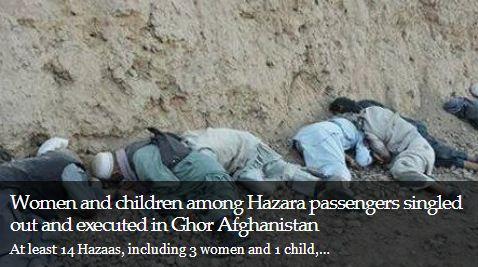
In the morning, the horrifying news struck to the national media and the social media networks. 15 innocent people were shot dead in Feroz Koh area including three women and a 9-month old child. Nobody was found injured. They were shot killed because they were Hazaras and Shias. Latifa’s body was lying dead beside her husband. Her hands were also tied on the back. She received several bullets but the bullet in the head took her life. She was killed because she was a Hazara and it was the only crime.

As routine, Kabul government issued clichéd statement vowing to bring terrorists to book. It’s worth mentioning, that for the past one month, around 50 Hazaras have so far been slaughtered by the religious terrorists in different parts of Afghanistan. No single terrorist in this regard was brought to justice, which is a matter of great concern for Hazaras in Afghanistan.

Angry protesters from different parts of Afghanistan including Kabul, Herath, Mazar-e-Sharif, Bamiyan and Daykundi even from Quetta City, Pakistan took to the street to express their solidarity with aggrieved family members and demanded Kabul Government to stop the killings of Hazaras in Afghanistan and provide full protection to its citizens. Many believe that if the recent ongoing Hazara killings were not stopped immediately by the government, it would further divide Afghanistan on ethnic lines.

The writer is a UK-based independent journalist and can be contacted at toyounasat@yahoo.co.uk. He tweets at @toyounasat. To read more articles, please visit http://myounas.com