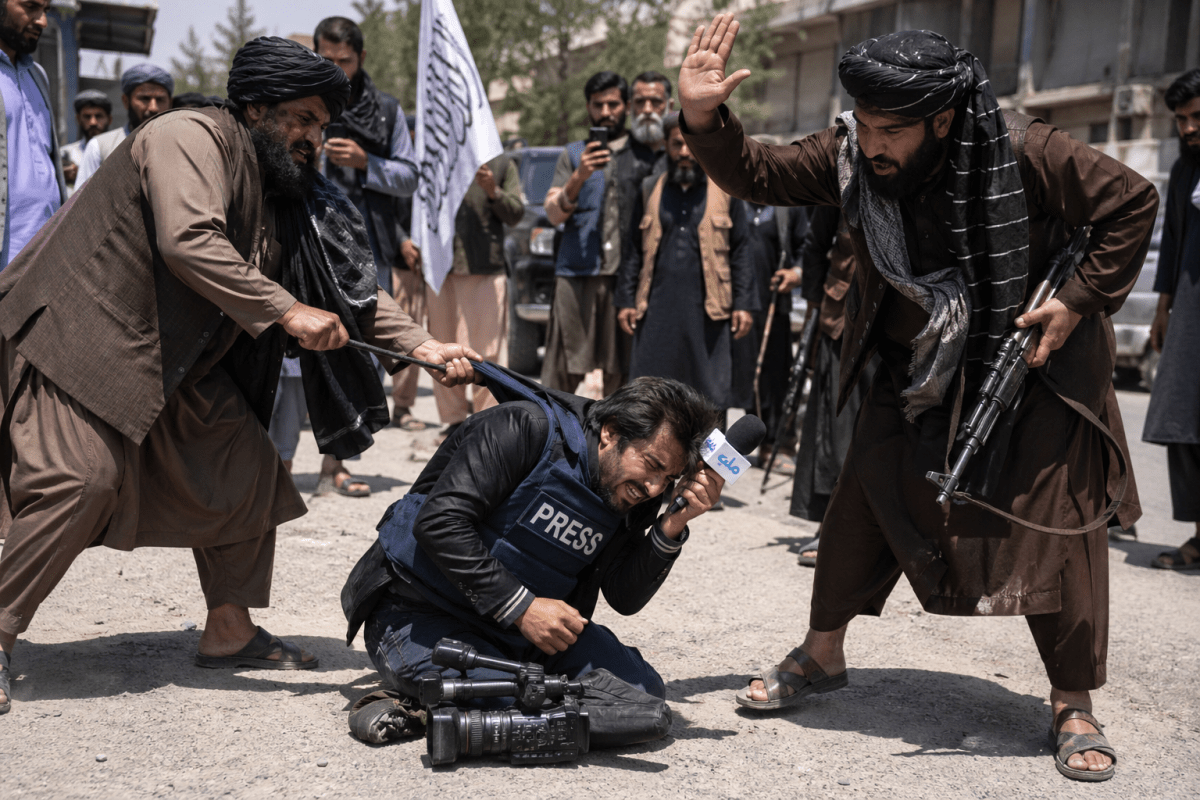
Journalists working under Taliban rule say a deepening crackdown has all but extinguished independent reporting in Afghanistan, replacing it with a tightly controlled system in which only approved narratives can be published.
In interviews, several reporters described an environment defined by fear, censorship and the constant threat of detention. They said media outlets operating inside the country are unable to report facts that contradict Taliban positions and are instead compelled to broadcast only what authorities permit.
“Journalists in Afghanistan say independent reporting has effectively collapsed under Taliban rule, with media outlets forced to publish only Taliban-approved narratives and no room for criticism,” 8AM Media reported.
“Even the smallest criticism can lead to humiliation, arrest or worse,” said one journalist in Kabul, who spoke on condition of anonymity for safety reasons. He added that reporters working with exile-based outlets also face severe obstacles, including difficulty verifying information and the risk of retaliation.
The Taliban, he said, view independent journalism as an ideological threat. That hostility, combined with a widening climate of fear among ordinary citizens, has sharply limited access to firsthand accounts. “People are afraid to speak,” he said. “Even those who have been directly harmed often refuse to share their stories.”
Doctors and other professionals who cooperate with independent media have also been punished, he said, sometimes through what he described as fabricated charges.
In western Afghanistan, a journalist who identified herself as Setara, a pseudonym, said access to information has become increasingly restricted and selective. Officials provide only what they choose to disclose, she said, and women journalists face additional barriers.
“They refuse to speak to us,” she said, explaining that authorities often cite the absence of a male guardian or demand that female reporters send male colleagues in their place.
Setara said she had been turned away from events multiple times simply because she was a woman. Such policies, she added, are steadily reducing the number of female journalists and further limiting the flow of information.
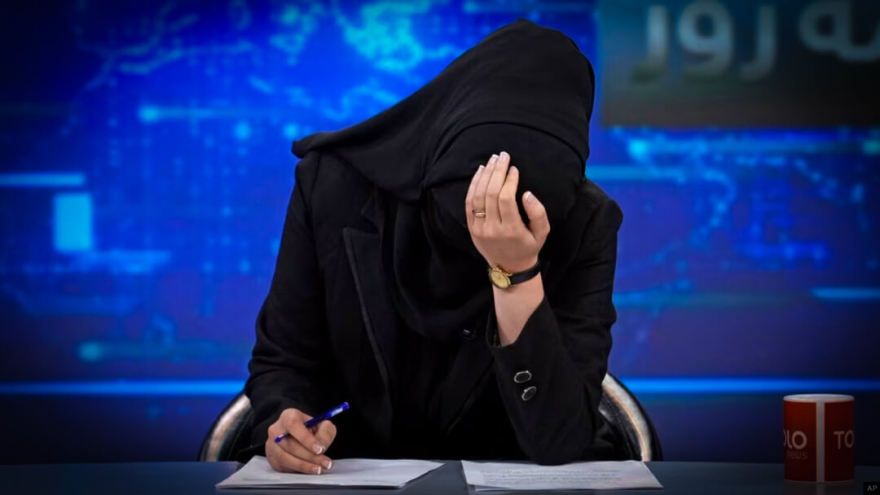
Photo: TOLO News, Afghanistan 2022
“Women journalists face additional discrimination, including denial of access to events and sources. Social media activity is monitored, and even minor critical posts can lead to punishment.” — 8AM Media
Another reporter, Mohammad, described the current period as the bleakest in Afghanistan’s recent history for media freedom. “There is nothing called access to information anymore,” he said. “It has collapsed.”
Others said even social media has come under scrutiny. Tabesh, another pseudonymous journalist, said that writing about crime or insecurity without aligning with Taliban messaging can result in arrest, torture and forced public apologies.
“Only those who act as a mouthpiece can operate freely,” he said. “They are rewarded, protected and promoted. But the smallest criticism carries the risk of prison.”
For many journalists, the choice is stark: comply or leave the profession. Ferdows, who works for a domestic outlet, said economic necessity has forced him to continue despite severe restrictions.
“Our work is entirely dictated,” he said. “Every word is checked to ensure it aligns with Taliban values.”
In recent weeks, journalists inside and outside Afghanistan have launched a campaign calling for the release of colleagues detained by the Taliban, some accused of collaborating with foreign-based media.
“Many journalists say they must either comply with Taliban messaging or leave the profession. Reporters face threats, arrest, torture, and public humiliation for dissenting coverage,” —Amin Kawa, 8AM Media.
Advocacy groups say several journalists remain in custody without access to legal representation and warn that their mental and physical conditions are deteriorating.
Concerns about press freedom have been echoed in recent reports by media watchdogs. They describe a sharp rise in censorship, intimidation and violence, alongside sweeping restrictions on broadcasting and reporting practices across much of the country.
Afghanistan now ranks near the bottom globally in press freedom assessments, reflecting what observers describe as the near-total dismantling of independent journalism.
For those still reporting, the risks remain constant—and the space for truth continues to shrink.
According to Amnesty International, the Taliban have continued to suppress freedom of expression by targeting independent media and arresting journalists on charges such as “moral corruption” and “espionage.” Restrictions have expanded to include bans on images of living beings in many provinces and the shutdown of media outlets like Radio Nasim. Authorities have also limited education and cultural expression by banning books written by women, restricting certain subjects, and prohibiting poetry critical of their rule. Individuals who publicly criticize the Taliban, including on social media, face arbitrary arrest and imprisonment.
@Basir Seerat

